Top Salesforce AI Use Cases That Will Transform Business Operations in 2027

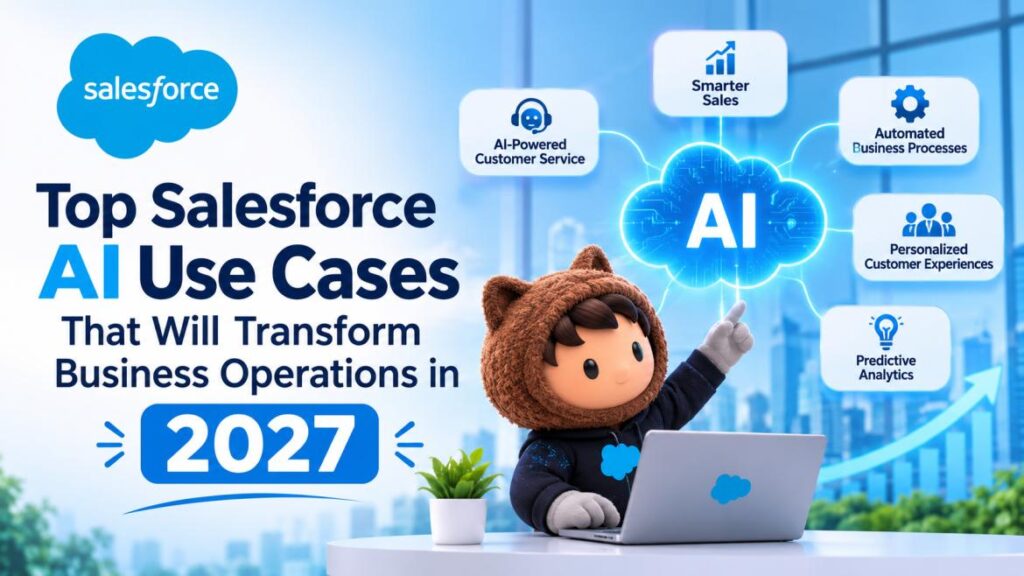
The one thing each and every Salesforce customer fears as we approach 2027 is whether they are using Salesforce to its fullest extent or falling behind businesses that know how to put AI to work properly.
It’s a fair question given how much has changed in just a few years. A CRM was once considered a place to keep customer information organized. Today, businesses are beginning to expect much more from it. They want technology that can understand a customer’s concern, help a salesperson prepare for the next conversation, and take routine work off an employee’s plate. Salesforce Agentforce, Einstein AI, and Data Cloud are helping make that shift possible.
With Salesforce generative AI services, businesses have the possibility to seek new approaches for automating the processes, personalizing interactions with their customers, and increasing efficiency. Whatever it may be: customer support, sales acceleration, employee enablement, and so on – AI is changing businesses.
So, which Salesforce AI use cases will make the biggest mark in 2027? Let’s explore five worth watching.
Salesforce AI: From Smart CRM to Intelligent Business Ecosystem
For years, Salesforce AI has provided businesses with ways to understand their customers’ data with the help of predictive recommendations and intelligent automation. With the advent of Agentforce, Salesforce has taken another leap forward with the integration of AI that does not only predict but also takes actions based on these predictions. This includes the comprehending customer requests, reasoning, and taking action via the very Flows, Apex and integrations that you already use in your org.
Three layers make that work. Data 360, previously called Data Cloud, consolidates the data of a customer across all systems so that the agent has an insight into it. The Atlas Reasoning Engine determines what action to perform, whereas the Einstein Trust Layer anonymizes the sensitive data before it enters the model. Above them are the Agentforce applications for Sales, Service, Marketing, and IT, and Slack where people and agents interact.
Top Salesforce AI Use Cases to Watch for in 2027
Dashboards report what happened. These five use cases act on it, and each rests on specific Salesforce building blocks.
1. Autonomous Customer Service and Resolution
The first agents to earn trust are the ones that close cases. The response of an Agentforce Service agent is based on Knowledge Articles and case history received from Data 360; thus, it addresses the specific customer’s inquiry rather than a general one. When the customer requests something such as cancelling the order or sending a new invoice, the Agent carries out the action through a Flow. In case the request falls outside its scope, it escalates the entire chat to a human through Omni-Channel, which is the Salesforce routing system, complete with the entire transcript. The Voice also uses the same agent as the chat, and therefore voice calls and messaging both follow the same guidelines.
2. Agentic Sales & Pipeline Acceleration
Sales agents pick up where reps fall short, which may include doing research on the accounts, qualifying the inbound leads, writing follow-ups, and creating quotes. Agents that specialize in these tasks come bundled in Salesforce for the respective jobs. Piper qualifies the leads in the inbound pipeline, whereas Hunter, whose release is expected in November 2026, is an outbound prospecting agent. Both have access to the Lead, Opportunity, and Activity object records, which makes permissions another limitation. It’s important to grant field access to the agent explicitly to prevent it from getting stuck at the very first locked field. The other limitation is data quality. The output from the agent qualifying leads from incomplete records will only be educated guesses and will not be taken into consideration by reps in no time.
3. Internal Operations & Employee Help Agents
Internal queues fill up with repeat questions: password resets, leave balances, device requests. Agentforce IT Service and HR Service answer them inside Slack, where people already work, and Paige is the job-ready agent Salesforce positions for IT and HR requests. The detail that matters most is identity. An employee-facing agent should act within the permissions of the person asking, not an administrator’s, otherwise you have built a privilege escalation tool with a friendly voice. Start by implementing answers such as policy searches and balance inquiries. Following the successful determination and charting of all approval flows, Action implementation may include access requests and equipment orders, allowing the agent to generate a ticket for the human if any approval was necessary.
4. Connected Marketing and Hyper-Personalization
While Agentforce Marketing handles campaigns and customer journeys, only the information stored in each profile determines how effective personalization turns out to be. Data 360 combines identities across web, commerce, service, and email to form a single profile, which allows for real-time segmentation and updates based on customer behaviors. How else can you make sure that a customer with an open case doesn’t receive a discount email? The service signal gets back to the marketing department in time. As for the consent, it’s all kept in the same profile, so managing opt-outs becomes just a matter of applying certain data rules rather than manually performing tasks. That is where Salesforce generative AI services offer the added benefit as they generate subject lines and messages’ variations. Every message goes through a marketer’s review before it reaches customers.
5. Industry-Specific Workflow Transformations
An industry agent functions because the data model is already designed for the specific operations. Agentforce Life Sciences deals with questions related to medical queries; Agentforce Manufacturing relies on sales and run rate data, and Agentforce Public Sector caters to citizens’ cases. The Field Service component enables hands-free data capture: the technician talks, and the Voice to Form module completes the work order, which the scheduling agent then reschedules. Industry policies determine the level of autonomy. An adverse drug event report requires an individual’s sign-off, while a parts availability inquiry doesn’t require one. A certified Salesforce consulting company that has implemented such data models earlier knows exactly when human intervention is needed in the regulated workflow.
How Salesforce AI Will Change Traditional Business Operations by 2027?
From an overhead view, all these use cases amount to an entirely new operating model. Activities shift from being queue-to-queue processes to becoming agent-to-person interactions where the human is responsible for handling exceptions, making decisions, and building relationships. Someone has to manage the agents—monitoring chats, tweaking Topics, and monitoring credit consumption. There will be more and more Salesforce support services that deal with agent management.
| Traditional business operations | AI-powered operations in 2027 |
| Manual lead qualification | Predictive lead qualification |
| Reactive customer support | Proactive AI-powered support |
| Static sales forecasts | Intelligent predictive forecasting |
| Manual data analysis | Conversational business intelligence |
| Rule-based workflows | Intelligent agent-driven workflows |
| Generic marketing campaigns | Hyper-personalized engagement |
Business Benefits of Implementing Salesforce AI
Faster resolution: Routine cases get resolved in the first conversation.
Lower cost to serve: Compare Flex Credit spend with cost per resolved case.
Wider coverage: Measure response time on inbound leads.
Better records: Check how many conversations end with a complete update.
Controlled growth: Review audit trails and permission exceptions each month.
Capturing these takes more than switching features on. Reliable Salesforce AI services combine architecture with change management, handling the less exciting work of preparing data before agents can utilize it. Post go-live, Salesforce support services help agents stay up-to-date as products and policies change.
Conclusion
Salesforce AI in 2027 isn’t about introducing yet another layer into your architecture. It’s about delegating specific processes to agents, keeping people involved in doing the work that requires human judgment, and holding it all accountable to the data and permissions that your org trusts. Begin with one workflow, measure it truthfully, and expand.



[…] CPQ technology can be a game changer for businesses looking to increase productivity and profitability. With the ability to automate complex pricing and quoting processes, sales teams can focus on […]