
Healthcare documentation is changing as physicians and other healthcare providers look for faster and more efficient ways to manage clinical notes without taking attention away from patients. Traditional medical transcription services have long supported this process by transforming physicians’ dictation into typed records. An AI medical scribe can listen to doctor-patient talks and create a draft quickly in real time. According to ResearchAndMarkets, this software market may grow to $5.08 billion by 2030, with a growth rate of 27.2% each year. This shows the increasing demand for automated medical notes. Faster note‑making doesn’t always mean better notes. Healthcare teams need to check how each method affects accuracy, doctor workflow, patient trust, EHR use, data security, and the time for final review before choosing the right solution.
What is an AI Medical Scribe?
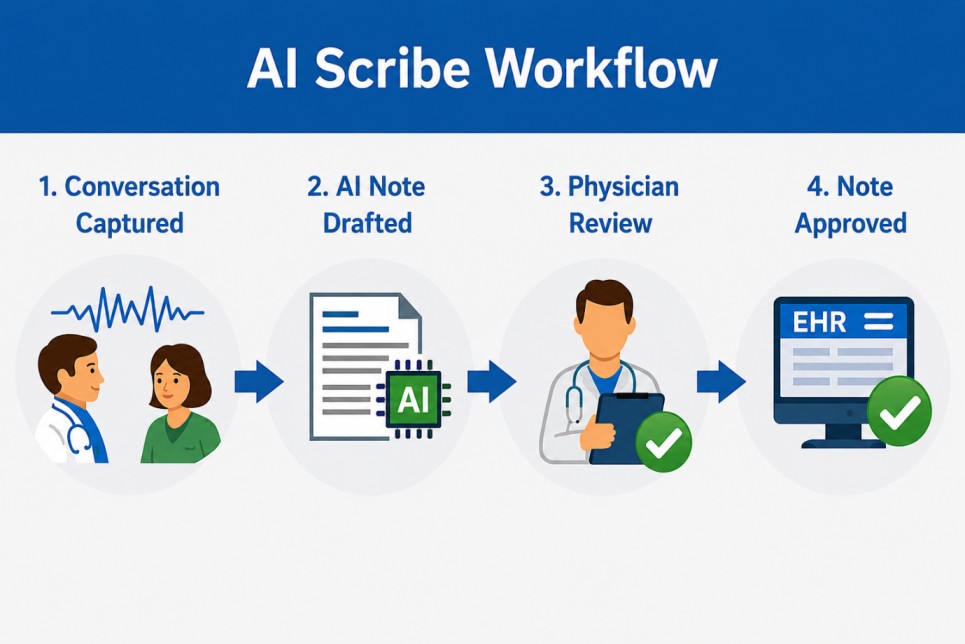
An AI medical scribe listens to doctor-patient conversations and makes draft notes. An ambient AI scribe operates in the background, organizes details, and connects with EHR systems. Healthcare professionals must review and approve these notes before they become part of patient records.
AI Medical Scribe: Pros and Cons
Pros:
- Faster Documentation: Reduces the time physicians spend writing and formatting notes after appointments.
- More Patient Interaction: Ambient AI scribe tools can help clinicians to focus on patient care and engage with patients during live conversations.
- Structured Notes: AI medical scribe software generates structured notes shortly after a clinical encounter.
- Standardized Documentation: Clinical documentation automation can standardize note formats across the practice or specialty
- Less repetitive EHR Work: AI scribes for physicians can reduce repetitive data entry and copy-and-paste tasks.
- Conversation Summaries: AI clinical documentation tools can summarize lengthy conversations into structured clinical notes
- Potential Burnout Reduction: Faster documentation workflow may help tackle physician burnout and documentation burden; AI medical scribes can reduce administrative overload by reducing repetitive documentation work
Cons:
- Accuracy Risks: AI-generated notes contain missing data, incorrect context, or inaccurate statements that need clinical review
- Privacy Concerns: Ambient recording can raise questions about patient consent, privacy, and comfort during clinical encounters.
- Audio Challenges: Accents, multiple speakers, Background noise, and specialty-specific terminology can affect the AI output quality.
- Compliance Considerations: AI medical scribe HIPAA compliance relies on the vendor’s security, implementation, data handling practices, and signed agreements.
What is Traditional Transcription?
Traditional medical transcription converts a physician’s recorded dictation into written clinical documentation, typically through a transcriptionist or transcription service.
Traditional Transcription: Pros and Cons
Pros:
- Human Judgment: Transcriptionists can understand unclear speech and handle complicated medical phrases.
- Specialty Fit: Traditional transcription can be useful for fields with technical language and detailed reports
- Quality Assurance: Human review helps to identify errors before the document is moved to the final stage
- Established workflows: Traditional transcription can fit organizations that are already using older dictation workflows.
Cons:
- Slower Turnaround: It generally takes longer than AI-assisted documentation because the recording must be processed before the document is returned.
- Additional Dictation: Physicians have to record notes after or between appointments
- High Costs: Traditional scribe services can add up quickly in busy practices with per-line or per-document pricing.
- Limited Context: Transcription is based on the physician’s dictation, not the full patient conversation
- Workflow Delays: Delayed records can slow billing, follow-up care, and completion of patient files.
Traditional transcription is still useful in some cases. It works well when a clinic needs very specific document formats, detailed surgery reports, or when recordings are hard to understand and don’t work well with automated speech tools.
AI Medical Scribe vs. Traditional Transcription: Key Differences
| Factor | AI Medical Scribe | Traditional Transcription |
| Primary Input | Doctor’s dictation or live patient talk | Doctor’s recorded dictation |
| Output Speed | Almost real-time drafts | Done after a waiting period |
| Documentation Style | Creates structured AI notes | Types out dictated content |
| Encounter Context | Can capture real-time conversation | Only context is what the doctor dictates |
| Human Role | Doctors edit and sign the AI draft | Transcriptionist types audio and doctor reviews it |
| Accuracy Concerns | May miss details or confuse speakers sometimes | May mishear or mistype medical terminology |
| Physician Workload | Reduces the typing effort and late-night work | Doctors need to give clear dictation |
| EHR Integration | Often integrates with supported EHR workflows | Need manual upload or transfer |
| Cost Structure | Subscription or usage-based pricing | Charged by line, minute, or document |
| Privacy Considerations | Needs strict controls for audio and data | Requires secure handling of audio and manual context |
Is an AI Medical Scribe More Accurate Than Human Transcription?
For organizations building customized clinical documentation workflows, healthcare app development can help connect AI documentation tools with existing healthcare systems and workflows.
AI scribes can create notes quickly, but they’re not always more accurate than human transcriptionists. AI can misinterpret medical words, negations, speakers, or clinical context, while human transcriptionists can better understand hard audio and special medical terminology.
The safest way is for doctors to review before signing any notes. Accuracy can change depending on the medical specialty, the type of visit, and the quality of audio recorded during the appointment. A simple follow‑up visit is usually easier for an AI scribe to summarize. But a complex consultation with multiple conditions, medicines, family history, or detailed treatment discussions is harder and needs more careful review. They should double-check all details like diagnoses, allergies, medicines, test results, and follow-up instructions.
Is an AI Medical Scribe HIPAA Compliant?
An AI medical scribe isn’t automatically HIPAA compliant; compliance depends on implementation and safeguards.
- Business Associate Agreement: A BAA may be required when a vendor handles protected health information on behalf of a covered entity.
- Data Encryption: Patient data should be encrypted during transmission and storage using appropriate security controls.
- Audit Logs: The system should keep records of who accessed or changed data
- Access Controls: Only authorized staff should be able to access patient information
- Data Handling Rules: Vendors must explain how recordings and transcripts are stored, deleted, or used.
- Physician Review: Doctors should always check and approve AI-generated notes before integrating them into the EHR.
AI Medical Scribes vs. Traditional Transcription: Which is the Best?
An AI medical scribe works better for clinics that need quick note-making, less paperwork, and more time for patients. It’s helpful in busy outpatient centers where doctors often complete notes after work.
Traditional transcription fits hospitals that need detailed reports, leverage complex medical language, prefer human review, or are not ready to use AI during patient visits.
Some organizations may use a hybrid workflow. This means AI can create a first draft of the encounter summary. Then, clinicians or human documentation specialists check complex cases, fill in missing details, and make sure the final note meets clinical and compliance standards. This approach reflects the broader use of AI in healthcare as providers look for practical ways to incorporate AI into existing workflows.
The best choice is not AI vs humans. A good documentation system should balance speed, accuracy, privacy, EHR use, doctor control, and review. For most healthcare providers, AI scribes will help draft notes, but doctors’ judgment will always matter most.
