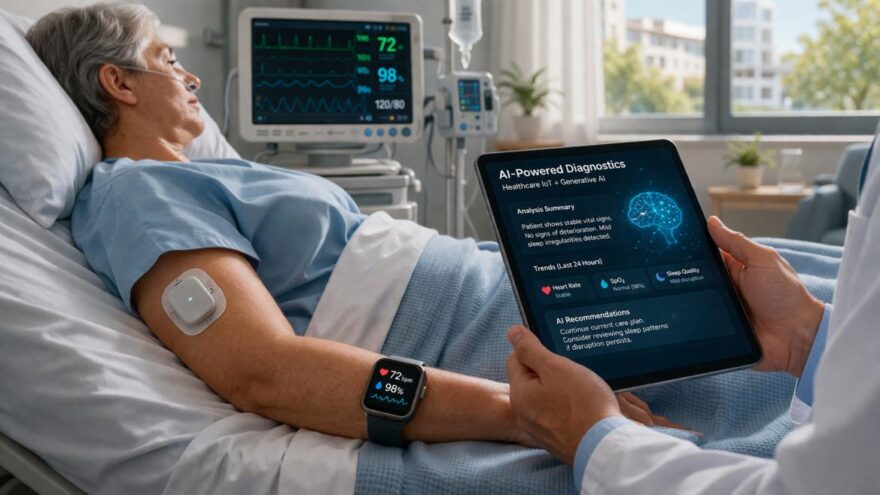
The introduction of IoT and AI is creating fundamental changes in healthcare as these technologies propel a move from being reactive in delivering care to being proactive/personalized in providing care. IoT and generative AI create opportunities to use real-time data from devices to provide meaningful/ actionable insights and enable continuous monitoring of individuals.
What is Healthcare IoT?
Healthcare IoT describes interconnected medical devices (wearable fitness tracker/smartwatch) and technology (i.e. hospital equipment connected with active ventilation system, remote patient observation) that will be able to monitor and transfer information regarding a patient’s health in real-time.
The real benefit of IoT healthcare devices is to have real-time visibility of your patient’s condition. Rather than using periodic visits to gain insight about a patient, the clinician has significant access to a live data feed showing changes in a patient’s overall health on a minute-by-minute basis throughout the entire day. This increases the ability for clinicians to make timely decisions about their patients’ care, as well as respond quickly to urgent changes in their health condition, which allows for more effective long-term management of their disease.
Generative AI in Medicine: An Overview
Generative AI uses machine-learning techniques that enable computers to generate new types of data output based on numerous distinct examples of previously collected (historical) datasets. The biggest advantage is that these models allow clinicians access to useful clinical summaries, predictions and possible diagnoses by analyzing much larger amounts of data than would usually be feasible with traditional analysis methods, especially when supported by a reliable generative AI development service.
Unlike classical pattern-matching algorithms, however, Generative AI can contextualize information and produce detailed reports based on what it has learned. Furthermore, Generative AI generates simulated outputs that demonstrate possible future outcomes given current conditions. Therefore, because of its capacity to provide answers quickly and precisely, this technology has a great deal of utility in applications where speed and/or accuracy are paramount.
The Convergence: IoT + Generative AI
When IoT and Generative AI create a shared ecosystem, exciting discoveries are created. The patient data collected from IoT devices is used in real-time by Generative AI to derive actionable intelligence and/or provide insight on the data received.
As a result of this “Data Feedback Loop,” clinicians now have insight into what has happened with the data, and can make more efficient, confident decisions to affect patient care. This has led to a transformation of the healthcare system and allows for care to be predictive and preventable.
Smarter Diagnostics
Diagnosis is being made better through the joining together of diagnostic capabilities. With all of this new data coming in, the AI models can find small differences that would never have been found.
For example, some new wearable technology can detect changes in the heart that may indicate a person is getting an irregular heartbeat (or arrhythmia), well before they start experiencing symptoms. Similarly, if your blood oxygen level and/or your pattern of breathing shows you are about to develop a lung disease, that’s an early indication that you may need additional testing or appropriate medical follow-up before you develop full-blown symptoms. Further enhancement of this ability will come through Generative AI’s capability to combine this real-time data with historical data to provide situational-contextual, or evidence-based, insight vs. independent alerts for patient care.
Similarly, the use of connected devices, such as MRI or CT scanners, to be integrated into AI systems that support radiologists via the identification and highlighting of anomalies, suggesting the most likely interpretations, and also creating drafts of reports, further reduces the radiologist’s workload and decreases the likelihood of making an error when interpreting images.
Personalisation of an individual’s diagnosis is also uniquely improved through the development of these new systems. Each person’s diagnosis is based on their individual, previous, culture, lifestyle, and physiology versus a standard (one size fits all) diagnosis. As such, this leads to a more accurate diagnosis and a better plan for treatment.
Intelligent Monitoring
With IoT and generative AI merging together, we usher in an era of intelligent monitoring beyond diagnostics! Now, you can be monitored as long as you are connected to the Internet, even when not in the formal healthcare system. The approach creates independence for individuals living with chronic illnesses because of fewer hospital visits, while also giving clinicians real-time, complete visibility into a patient’s overall health. Generative AI can assist clinicians by quickly summarizing long-term data trends, identifying future risk areas, and providing alerts to the clinician prior to a patient’s condition deteriorating.
An example is predictive capabilities. AI models analyze historical trend data to determine possible future events, such as heart failure episodes or diabetic complications. Early intervention by healthcare providers is possible using predictive models and prevents many emergency situations.
Generative AI also automates the creation of clinical documentation for healthcare professionals. Instead of reviewing large amounts of data manually, practitioners receive concise, structured reports focusing on key pieces of data.
Benefits for Healthcare Stakeholders
Patients will have greater access to more personalized treatments through the use of technology, which will lead to earlier diagnosis and decreased dependence on hospitals. Providers will have easier time diagnosing patients, lower administrative burden, and more efficient operations.
On the systems-level side, organizations will be able to more easily allocate their resources and will experience lower operational costs. But, perhaps most importantly, they will now be able to scale their services without compromising quality.
Obstacles and Issues
There are many obstacles/considerations associated with merging IoT and generative AI, even though it has great potential. The key issues are data privacy and security because all health data must be protected at every point in time and throughout its life cycle. In addition, the devices or platforms will not provide an effective result if they do not work together (i.e. they will not communicate well with each other).
Working within regulations creates yet another layer of complexity, as there are strict requirements for compliance with laws and regulations (i.e. HIPAA, GDPR). Reliability and fairness of AI models must also be considered, as incorrect conclusions produced by AI may significantly affect clinical decisions that rely on these AI-generated conclusions.
Conclusion
Generative artificial intelligence, integrated with the healthcare IoT, is changing how digital records are created for every patient as well as changing how patients are monitored on an ongoing basis. The data generated, when converted into useable forms of insights, will enable healthcare providers to provide their patients with better care at a faster pace.
Those organizations embracing this shift will not only achieve improved patient outcomes but also load themselves up with an opportunity to be the leaders of the future of digital healthcare.

1 thought on “Healthcare IoT + Generative AI: Smarter Diagnostics and Monitoring”